



Food Safety
Aflatoxin M1 in Dairy: What Dairy Processors Need to Know
Aflatoxin M1 in Dairy: What Dairy Processors Need to Know
Aflatoxin M1 (AFM1) is a global dairy food-safety concern that can occur when milk-producing animals consume feed contaminated with Aflatoxin B1 (AFB1). This guide explains the feed-to-milk pathway, AFM1 testing across dairy production, the effect of heat processing, and regulatory requirements across major markets including the European Union, United States, China, India, Japan and South Korea. It also explores how supplier assurance, incoming-milk controls and quantitative ELISA testing can support risk-based dairy food-safety and quality programmes
Aflatoxin risk in dairy can begin before milk ever reaches the processing plant.
Upstream control can therefore include both targeted AFB1 testing and broader Total Aflatoxin screening of relevant feed and raw materials before AFM1 becomes a downstream milk concern.
Aflatoxin B1 (AFB1) can contaminate crops and ingredients used in animal feed. When dairy animals consume feed containing AFB1, part of that toxin can be metabolized into Aflatoxin M1 (AFM1) and subsequently excreted into milk. This creates an important connection between feed quality, supplier assurance, incoming milk control and dairy food safety.
For dairy processors, managing AFM1 is therefore not simply a finished-product testing issue. Effective risk management starts by understanding where the hazard originates, how it reaches the dairy supply chain, which regulatory requirements apply and where analytical testing can support appropriate control decisions.
What is Aflatoxin M1?
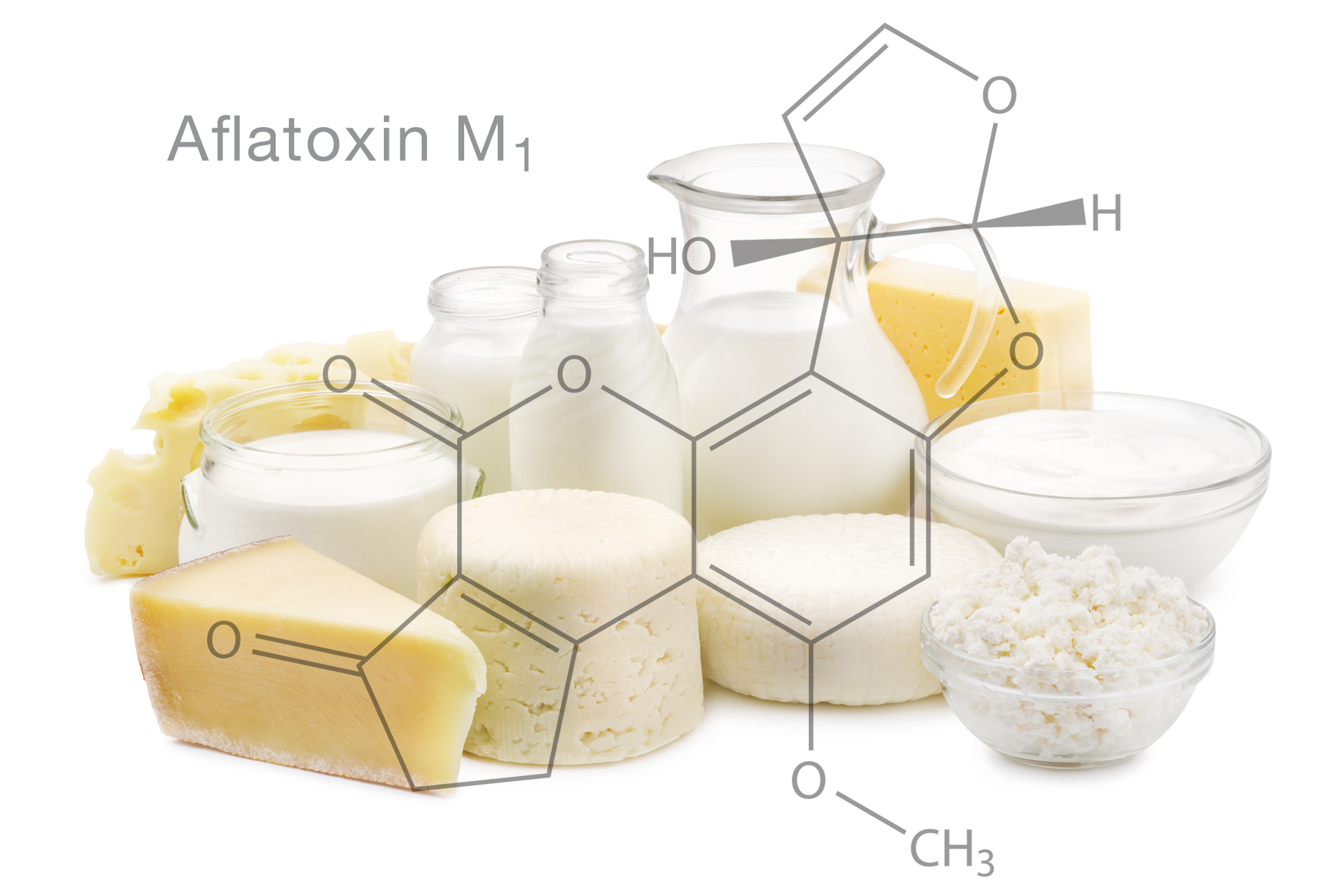
Aflatoxin M1 is a metabolite of Aflatoxin B1 that can occur in milk and dairy products when milk-producing animals consume feed contaminated with AFB1.
Aflatoxins are naturally occurring mycotoxins associated with certain molds. AFB1 is one of the most significant members of this group and can contaminate agricultural commodities used in animal feed.
After contaminated feed is consumed, AFB1 can be metabolized by the animal. One of the resulting metabolites is AFM1, which can be transferred into milk. The European Food Safety Authority, therefore, identifies contaminated animal feed as the key upstream pathway linking AFB1 to the occurrence of AFM1 in dairy products.
For dairy manufacturers, that creates a simple but important risk pathway:
AFB1 in feed → dairy animal consumes contaminated feed → AFB1 is metabolised → AFM1 can occur in milk
Understanding this pathway is important because it shifts the discussion from simply detecting a contaminant in milk to managing risk across the wider dairy supply chain.
What is the difference between Aflatoxin B1 and Aflatoxin M1?
Although closely related, AFB1 and AFM1 occur at different stages of the dairy supply chain.
| Aflatoxin B1 | Aflatoxin M1 | |
|---|---|---|
| Common abbreviation | AFB1 | AFM1 |
| Primary source | Contaminated crops/feed ingredients | Metabolism of AFB1 by milk-producing animals |
| Relevant Dairy stage | Feed and supplier inputs | Milk and dairy products |
| Typical control focus | Feed/raw-material monitoring | Incoming milk and dairy-product testing |
| Dairy relationship | Upstream precursor | Downstream milk metabolite |
AFB1 may be tested specifically, but upstream mycotoxin programs can also monitor Total Aflatoxins, which typically include Aflatoxin B1, B2, G1 and G2. The appropriate approach depends on the commodity, regulatory or customer requirement and the purpose of the testing program.
This distinction matters when designing a testing program. Testing milk for AFM1 addresses the contaminant that has entered the dairy stream, while feed testing for AFB1 can support upstream risk management before that transfer occurs.
How does Aflatoxin M1 get into milk?
AFM1 does not normally originate from contamination introduced within the dairy plant.
The risk begins upstream.
Certain agricultural commodities used in animal feed can become contaminated with aflatoxins. Environmental and crop conditions can influence the development of aflatoxin-producing molds and the resulting risk in feed materials. FDA guidance, for example, identifies crop stress, including drought and insect damage, as factors associated with aflatoxin contamination.
When a dairy animal consumes feed containing AFB1, the compound can be metabolized, and AFM1 may subsequently be excreted in milk.
This means dairy AFM1 risk management can involve several organizations and functions, including:
- Feed producers and suppliers
- Dairy farms
- Supplier-quality teams
- Milk collection operations
- Incoming raw-milk laboratories
- Dairy QA/QC laboratories
- Food safety and regulatory teams
For integrated dairy businesses, understanding both feed and milk risk may therefore be particularly important.
Why should dairy processors monitor Aflatoxin M1?
Aflatoxin control is a food-safety and regulatory issue.
The European Food Safety Authority assessment of aflatoxins treats them as genotoxic and carcinogenic contaminants for which dietary exposure should be minimized. AFM1 is less potent than AFB1, but its occurrence in widely consumed foods such as milk makes monitoring important.
From an operational perspective, AFM1 contamination can also create challenges, including:
- Non-compliance with applicable regulatory limits;
- Failure against customer or export specifications
- Rejected incoming milk
- Supplier-management issues
- Additional analytical investigation
- Product disposition decisions
- Potential disruption to production or supply
The appropriate control program will depend on market, product, supply chain and risk profile.
What are the regulatory limits for Aflatoxin M1 in milk?
There is no single global AFM1 limit.
Requirements differ significantly between jurisdictions, making it important for dairy processors to understand the regulations that apply to both their production market and destination markets.
International Benchmark - Codex Alimentarius
Codex Alimentarius provides an important international reference point for AFM1 control. Codex has established a maximum level of 0.5 μg/kg for AFM1 in milk and has also developed guidance on reducing Aflatoxin B1 contamination in feed for milk-producing animals.
This is particularly relevant to dairy because it connects upstream feed control directly with downstream AFM1 risk in milk; because AFM1 risk originates upstream, Codex also recognizes the importance of controlling AFB1 contamination in feed for milk-producing animals.
European Union
Under Commission Regulation (EU) 2023/915, the maximum level for AFM1 in raw milk, heat-treated milk and milk intended for the manufacture of milk-based products is:
0.050 μg/kg - equivalent to 50 ng/kg or approximately 50 ppt.
More stringent requirements apply to certain products intended for infants and young children.
North America
United States
The U.S. Food and Drug Administration establishes an action level of:
0.5 ppb AFM1 in milk.
This is equivalent to 500 ppt, illustrating the considerable variation that can exist between regulatory markets.
Dairy manufacturers exporting internationally may therefore need testing programs capable of meeting requirements more stringent than those applicable in their domestic market.
Mexico
Mexico also regulates AFM1 in relevant milk and dairy categories. NOM-243 establishes a maximum level of 0.5 μg/L for applicable milk, milk formula and combined dairy-product categories.
Mexico also maintains analytical standards for determining AFM1 in milk and milk powder, reinforcing the importance of appropriate analytical controls for dairy manufacturers supplying this market.
Asia-Pacific
AFM1 is also subject to specific regulatory controls across several major Asian dairy markets. This makes mycotoxin control relevant not only to domestic dairy production, but also to manufacturers exporting milk, dairy ingredients and nutritional products within the region.
China
Chinese regulatory material specifies a maximum level of 0.5 μg/kg of AFM1 in milk and related milk products.
For dairy manufacturers supplying the Chinese market, AFM1 therefore represents a defined regulatory consideration alongside broader feed and raw-material mycotoxin controls.
India
India regulates AFM1 in milk and milk products through the Food Safety and Standards Authority of India (FSSAI), with a limit of 0.5 μg/kg for relevant milk categories.
India is also particularly relevant from a risk-management perspective because national milk surveillance has highlighted the link between contaminated feed and fodder and AFM1 in milk.
Japan
Japan treats milk containing AFM1 at concentrations above 0.5 μg/kg as non-compliant under its food-safety framework.
Japan also distinguishes between official analytical methods and screening methods for AFM1, illustrating that laboratories may need to consider both routine screening and confirmatory analysis depending on their regulatory purpose.
South Korea
South Korea also maintains specific requirements for AFM1 in milk and dairy production. Dairy manufacturers supplying this market should confirm the current MFDS maximum level and analytical requirements applicable to their product category.
Latin America
AFM1 requirements also vary across Latin America, and in some markets, the permitted level differs depending on the dairy matrix being tested.
Brazil
This is the strongest example to include.
Brazil demonstrates why dairy manufacturers need to consider both the market and the matrix when defining an AFM1 program.
Brazilian regulatory material specifies different maximum levels according to the dairy product:
Fluid milk: 0.5 μg/kg
Milk powder: 5 μg/kg
Cheese: 2.5 μg/kg
Regulatory Approaches Can Differ: Canada and New Zealand
Canada
Health Canada maintains enforceable maximum levels for chemical contaminants in foods, but the current national lists do not establish a specific AFM1 maximum level for milk or dairy products. Health Canada's current contaminant lists include aflatoxin limits for nuts, for example, but not a dedicated AFM1-in-milk limit.
This means Canadian dairy businesses should not assume that the absence of a specific domestic maximum for AFM1 milk eliminates the need for risk management. Product specifications, customer requirements, international standards and requirements in destination markets may still influence testing decisions.
New Zealand
New Zealand Food Safety operates a National Chemical Contaminants Program (NCCP) for dairy products. The program monitors chemical contaminants and establishes Action Limits for the parameters being tested. These Action Limits take account of New Zealand requirements, Codex limits and the requirements of destination markets. Importantly, MPI states that the applicable Action Limit can reflect the lowest allowable limit among New Zealand, Codex and destination-market requirements.
New Zealand dairy producers must also comply with contaminant controls under the Animal Products framework and relevant dairy risk-management requirements.
This illustrates an important principle:
The testing threshold that matters operationally may be driven by the destination market rather than by a single domestic AFM1 limit.
Always be sure to note
Regulatory requirements can change and may vary by product category and jurisdiction. Dairy manufacturers should always confirm the applicable regulations and customer specifications for their products and markets.
| Market | Example AFM1 requirement | Important consideration |
|---|---|---|
| Codex | 0.5 μg/kg milk | International reference point |
| European Union | 0.050 μg/kg | General milk limit is substantially lower |
| United States | 0.5 μg/kg/ppb | FDA action level |
| China | 0.5 μg/kg | Milk/relevant milk products |
| India | 0.5 μg/kg | Relevant milk categories |
| Japan | 0.5 μg/kg | Regulatory threshold plus a defined analytical approach |
| Brazil | Matrix-specific | Different levels for fluid milk, powder and cheese |
| Mexico | 0.5 μg/L | Relevant milk/dairy categories |
| Canada | No specific national AFM1 milk ML identified in current Health Canada contaminant lists | Customer/export requirements may still apply |
| New Zealand | Risk- and export-market-based monitoring framework | NCCP Action Limits can reflect the most stringent applicable market requirement |
Why destination market matters
For globally traded dairy products, the relevant analytical threshold may not be determined solely by the country of manufacture.
New Zealand's dairy-monitoring framework provides a clear example: Action Limits used within the National Chemical Contaminants Program can take account of New Zealand requirements, Codex and destination-market limits, with the most stringent applicable requirement influencing the control level.
Similarly, the absence of a specific domestic AFM1 maximum level does not necessarily mean AFM1 testing is irrelevant. Export specifications, customer requirements and international standards can still determine the level of monitoring a dairy manufacturer needs to maintain.
Dairy businesses should therefore consider:
- domestic legislation;
- destination-market regulation;
- customer specifications;
- dairy matrix;
- intended consumer;
- required analytical sensitivity.
Does pasteurization remove Aflatoxin M1 from milk?
Routine pasteurization should not be relied upon as a control step for AFM1.
AFM1 is relatively heat-stable, and studies have detected it in both pasteurized and raw milk. Research examining AFM1 during milk processing has also reported that the toxin can persist after conventional dairy heat treatment.
This distinguishes mycotoxin control from microbiological hazards that may be addressed through validated thermal processing.
A dairy manufacturer should therefore not assume that pasteurization will make AFM1-contaminated milk acceptable.
The stronger preventive approach is to manage the risk through appropriate feed controls, supplier assurance, incoming milk monitoring and analytical testing.
Does UHT processing remove Aflatoxin M1?
UHT processing should likewise not be treated as a dependable AFM1 control measure.
AFM1 has been documented in commercially available UHT milk, and its relative heat stability means thermal treatment alone cannot replace effective upstream controls and testing.
This is particularly important for shelf-stable dairy manufacturers.
UHT processing may deliver commercial sterility by controlling relevant microorganisms, but microbiological commercial sterility and chemical contaminant control are different food-safety challenges.
An effective UHT dairy quality program, therefore, needs to consider both.
Which dairy products may require consideration for AFM1?
AFM1 risk begins with milk, but testing requirements can extend across different dairy matrices depending on regulation, product formulation and customer requirements.
Relevant matrices may include:
- Raw milk
- Pasteurized or homogenized milk
- UHT milk
- Milk powder
- Cheese
- Yogurt and cultured dairy products
- Dairy ingredients
- Milk-based nutritional products
Regulatory limits may also vary according to the dairy matrix. Brazil, for example, applies different AFM1 maximum levels to fluid milk, milk powder and cheese. This reinforces the importance of considering both analytical matrix validation and applicable product-specific regulation when designing a testing program.
The appropriate analytical method should be validated for the matrix being tested.
This is especially important because processing can alter the composition of dairy products and affect analytical performance. A method validated for fluid milk should not be automatically assumed to perform identically in cheese, powder or other complex dairy matrices.
Where should Aflatoxin M1 testing fit within a dairy food safety program?
There is no universal testing point or frequency appropriate for every dairy business.
Testing should form part of a risk-based control program, informed by factors such as feed and supplier risk, geographic conditions, historical results, regulatory requirements, customer specifications, dairy matrix and intended market.
A useful way to think about AFM1 control is in terms of three connected stages.
1. Feed and supplier inputs
Feed manufacturers, farms and vertically integrated dairy operations may monitor AFB1 or Total Aflatoxins in feed and raw materials to help identify risk earlier in the supply chain.
The appropriate testing strategy depends on the testing objective. Targeted AFB1 testing may be appropriate where the specific precursor to AFM1 is the primary concern, while Total Aflatoxin testing can provide broader screening for Aflatoxin B1, B2, G1 and G2 in relevant feed and agricultural commodities.
These upstream controls do not replace AFM1 testing in milk, but they can strengthen supplier assurance and help identify aflatoxin risk before affected feed contributes to downstream dairy exposure.
2. Incoming raw milk
For dairy processors, raw-milk reception can represent an important control point.
Testing at or around intake can help identify elevated AFM1 concentrations before affected milk moves further into production.
The appropriate sampling and decision process should be defined within the processor's quality system.
3. Dairy QC and finished products
Depending on product, market and regulatory requirements, testing may also be performed within the dairy QC laboratory or on relevant processed products.
The aim is not necessarily to test at every stage, but to establish controls that provide appropriate confidence for the organization's risk profile.
For products intended for export, the required decision threshold may be determined by the destination market rather than the country in which the dairy product is manufactured.
How is Aflatoxin M1 detected in milk?
Several analytical approaches can be used to determine AFM1, including chromatographic and immunochemical methods.
For routine dairy quality-control laboratories, enzyme-linked immunosorbent assay (ELISA) provides one option for quantitative screening.
Competitive ELISA methods use antibodies that recognize the target analyte and generate a measurable response that can be used to calculate the concentration of AFM1.
An effective routine method should be selected based on factors including:
- Required detection capability
- Applicable regulatory threshold
- Validated dairy matrices
- Sample throughput
- Sample preparation requirements
- Laboratory equipment
- Time to result
- Required precision and accuracy
- Confirmatory-testing procedures
Where results require regulatory confirmation or further investigation, laboratories should follow the analytical and confirmation procedures required by their applicable program or authority. The distinction between screening and confirmatory testing can also vary by jurisdiction. Japan, for example, specifies official chromatographic methods alongside criteria for AFM1 screening approaches.
Aflatoxin testing across the dairy supply chain with Hygiena®
Hygiena® offers quantitative Helica® ELISA solutions for AFM1 testing across dairy matrices.
The Helica Aflatoxin M1 Quantitative ELISA is a competitive enzyme immunoassay designed for quantitative detection of AFM1. Hygiena lists the assay as validated for raw milk, homogenized milk, skim milk powder and yogurt, with a quantitative range of 0-100 pg/mL. The current product format provides 96 reactions and can process up to 42 samples in approximately 90 minutes.
Hygiena also offers additional AFM1 ELISA formats for matrices such as milk, milk powder and cheese, allowing laboratories to select an assay based on their validated matrix and testing requirements.
Helica Aflatoxin B1 Low Matrix ELISA (KIT5005) supports quantitative targeted detection of AFB1 in relevant commodities, including matrices that can present higher matrix effects, such as silage.
Helica Total Aflatoxin Rapid ELISA (KIT5007) provides quantitative detection of Aflatoxin B1, B2, G1 and G2 in a single assay across validated commodities, including cereals and animal feeds. Hygiena currently positions the assay for supplier verification and mycotoxin monitoring, with a 96-well format and rapid workflow.
Explore Total Aflatoxin Testing
Used in the appropriate applications, upstream AFB1 or Total Aflatoxin screening and downstream AFM1 milk testing can support a more connected approach to aflatoxin risk across the dairy supply chain.
Supporting dairy testing standards
Effective food-safety testing depends not only on analytical technology but also on appropriate methods, standards and scientific collaboration.
Hygiena participates in the International Dairy Federation through the U.S. and German National Committees. Hygiena Senior Global Product Manager Nate Banner has also described prior involvement in developing a standard on rapid methods for detecting Aflatoxin M1.
This standard's involvement supports Hygiena's wider approach to dairy testing, from upstream risks and incoming milk through processing, environmental monitoring and finished-product quality.
Read about Hygiena and the International Dairy Federation
Frequently Asked Questions
What causes Aflatoxin M1 in milk?
AFM1 can occur when milk-producing animals consume feed contaminated with Aflatoxin B1. The animal metabolizes AFB1, and AFM1 can subsequently be excreted into milk.
What does Total Aflatoxin testing measure?
Total Aflatoxin testing can measure multiple aflatoxins, typically including Aflatoxin B1, B2, G1 and G2. In a dairy supply chain context, it may be used to provide broader screening of relevant feed and raw material commodities before milk production.
Is Aflatoxin M1 the same as Aflatoxin B1?
No. AFB1 is the parent aflatoxin commonly associated with contaminated crops and animal feed. AFM1 is a metabolite that can occur in milk after an animal consumes AFB1-contaminated feed.
Can pasteurization eliminate Aflatoxin M1?
Routine pasteurization should not be relied upon to control AFM1. AFM1 is relatively heat-stable and has been detected in pasteurized dairy products. Preventive feed controls and appropriate analytical testing remain important.
Can Aflatoxin M1 occur in UHT milk?
Yes. AFM1 has been detected in UHT milk, so UHT processing should not be considered a substitute for upstream mycotoxin controls or appropriate testing.
Are Aflatoxin M1 limits the same worldwide?
No. AFM1 requirements vary by jurisdiction and sometimes by dairy matrix or intended consumer. For example, the general EU maximum for relevant milk categories is 0.050 μg/kg, whereas several other major markets use 0.5 μg/kg.
How do laboratories test milk for Aflatoxin M1?
Methods include chromatographic and immunochemical techniques. Quantitative competitive ELISA can provide an efficient routine screening approach for dairy QC laboratories when the assay is appropriate and validated for the matrix and required detection level.
Where should dairy manufacturers test for Aflatoxin M1?
The appropriate point depends on the risk-based food safety program. Controls may include feed or supplier monitoring, incoming raw milk testing and testing of relevant dairy products. Testing location and frequency should reflect applicable regulations, historical risk, supplier controls, product matrix and customer requirements.
Which AFM1 limit should an exporter follow?
Exporters should consider the regulatory requirements and customer specifications applicable to the destination market and specific dairy product. Where destination-market requirements are more stringent than domestic requirements, the testing program may need to support that lower threshold.
Should dairy businesses test AFB1 or Total Aflatoxins in feed?
The appropriate approach depends on the commodity, regulatory or customer requirement and testing objective. Targeted AFB1 testing focuses specifically on the aflatoxin that can give rise to AFM1 in milk, while Total Aflatoxin testing provides broader screening for multiple aflatoxins. Testing methods should be selected according to the validated matrix and requirements of the individual control program.
Managing Dairy Risk from Feed to Finished Product
AFM1 demonstrates why dairy food safety cannot always begin at the processing line.
The pathway starts upstream with the potential for AFB1 contamination in animal feed, continues through milk production and can ultimately affect dairy manufacturing and product compliance.
For dairy processors, the most effective strategy is therefore to understand the complete pathway:
Feed & raw-material risk → AFB1 / Total Aflatoxin controls → supplier assurance → AFM1 in incoming milk → dairy QC → product decision
For global manufacturers, the destination market and product matrix should also inform the analytical sensitivity and decision limits built into that testing program.
Combining appropriate supplier assurance with sensitive, matrix-appropriate analytical testing can help dairy organizations identify risk earlier and make informed decisions before affected material moves further through production.
Want to discuss your dairy testing program?
Could you talk with Hygiena about your matrices, regulatory requirements, testing volumes and current workflow?


