



Outsourcing pathogen testing? You still own the result.


Outsourced pathogen testing
Contract laboratories give manufacturers access to accredited testing, validated methods and trained analysts without building the capability in-house. The manufacturers who get the most out of that arrangement are the ones who know it best. What method sits behind the result. What the validation covers. How the numbers from one site compare with another.
Here is what to expect from outsourced pathogen testing, and what to ask for if you are not getting it.
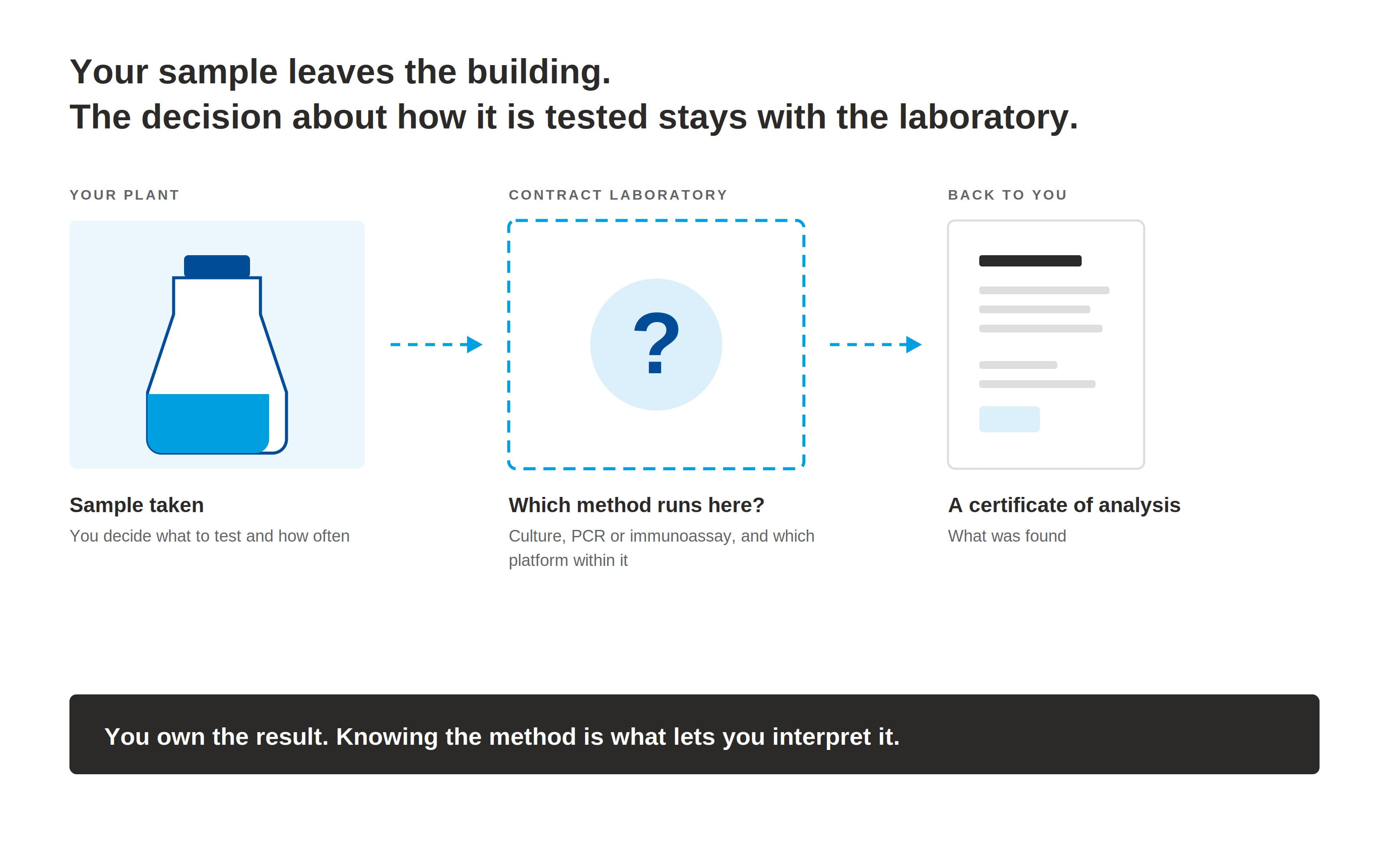
Three questions about your outsourced pathogen testing

Not which laboratory. Which method: Culture, PCR, immunoassay? and which platform within the selected method.
Certification and validation are not the same claim. A method certified for one food type is not automatically appropriate for yours.

Not the certificates. The results themselves, in a form you can trend, compare across sites and hand to an auditor. Short-term trends tell you whether something has shifted this month. Long-term trends show you where the recurring hot spots in your workflow are. Most in-house testing already works this way. Outsourced pathogen results often arrive as individual reports in a separate system, which makes collating and consolidating twelve months of them a manual exercise.
What questions should you ask a food testing laboratory?

ISO/IEC 17025 covers specific methods and matrices, not everything. Ask which organisms sit in scope, and check the published listing.

Ask which method runs on your samples, and whether its certified scope covers your specific matrix, not just your category.

A presumptive holds product until answered. Ask how quickly you are told, by what route, and with what detail.

Ask what happens between presumptive and final, how long each step takes, and what they do with an ambiguous result.

Ask for structured data, not PDF only. Reconciling results by hand across sites is a cost most teams never measure.

If you use more than one laboratory, ask whether they run the same method. If not, results are not comparable.
What does a pathogen result actually cost?
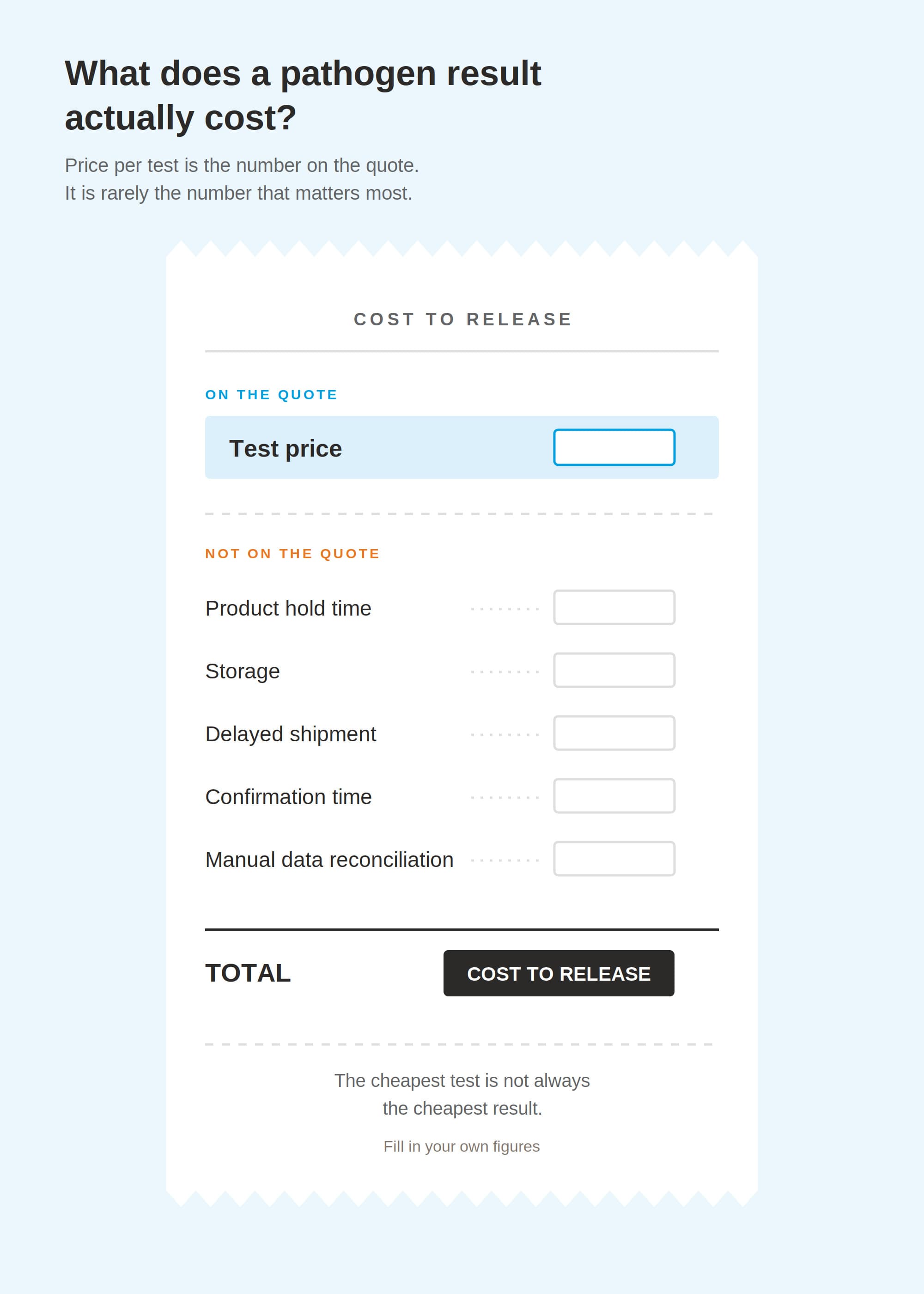
Ask how long the method takes to a result, and what that means for when you can release product. Price per test is the number on the quote. It is rarely the number that matters most.
Test price
+ product hold time
+ storage
+ delayed shipment
+ confirmation time
+ manual data reconciliation
= total cost to release
Worth asking whether the method is the right fit for your product and your operation, rather than accepting whichever one is quoted.
Why do the testing methods behind your results matter?
A certificate of analysis tells you what was found. It does not usually tell you how.
The method is a decision, and it is made by whoever runs your testing. That decision affects how quickly you get an answer, how confident you can be in it, how long product sits on hold, and whether the result can be compared with the one from your other plant.
Your laboratory makes that decision with good reason. They know their instruments, their scope and their throughput. Knowing what they chose, and why, is what lets you interpret a result rather than just receive one.

A presumptive result starts a process. Confirmation exists to work out which of several explanations applies: the organism, the method, the matrix, or how the sample was taken and transported. Knowing the screening method, the confirmation method and the laboratory protocol tells you what happens next and how quickly you reach an actionable answer.

Most testing agreements specify the organism, the sample type and the frequency. Fewer specify the method. So when a second site uses a second laboratory, both may be running exactly what you asked for, on different platforms. Two sets of results that look comparable, and are not. Corporate quality sees a trend. What it is actually seeing is two methods.
So the question worth carrying into your next laboratory review is a simple one.
Do you know which method sits behind your pathogen results, and could you find out today?
What this looks like with the BAX® System and foodproof®
BAX® System and foodproof® are real-time PCR assays covering Salmonella, Listeria, STEC, Campylobacter, Cronobacter, Norovirus and more.
Check the Validation Finder. If your matrix is not covered, ask how the laboratory verified it under its own conditions.
Validated to ISO 16140-2 and certified under internationally recognized schemes, independent of the manufacturer.
Molecular confirmation targets a different genetic region, so it is an independent check rather than a repeat. Hours, not days.
Lyophilized reagents, an internal control on every reaction, and automated call logic remove operator judgment from the result.
Results connect to SureTrend® alongside your environmental monitoring and ATP data. Where your laboratory is connected, outsourced results appear too.
Direct access to application scientists, including outside standard hours. Most calls come during a presumptive, when the answer matters most.
Frequently asked questions
What is a contract food testing laboratory?

Can I ask my contract laboratory which method they use?
Can I ask my laboratory to use a specific method?
Do Health Canada and ISO 16140-2 certifications mean the method is validated for my product?
What happens when a contract laboratory reports a presumptive positive?
Is the cheapest pathogen test the cheapest option?
Why do results from two laboratories not always match?
Should I test in-house or use a contract laboratory?